Anonymised cloud architecture studies and attributed vendor reference blueprints. Each entry describes the design, technologies and scope of the work.
Microsoft reference blueprint
Enterprise Azure Landing Zone — Hub & Spoke
An enterprise-scale Azure foundation spanning management groups, platform subscriptions, identity, security, connectivity, governance, observability, automation, and isolated workload landing zones.
- Azure Landing Zones
- Management Groups
- Microsoft Entra ID
- Hub-Spoke Networking
- Azure Firewall
Architecture and approach
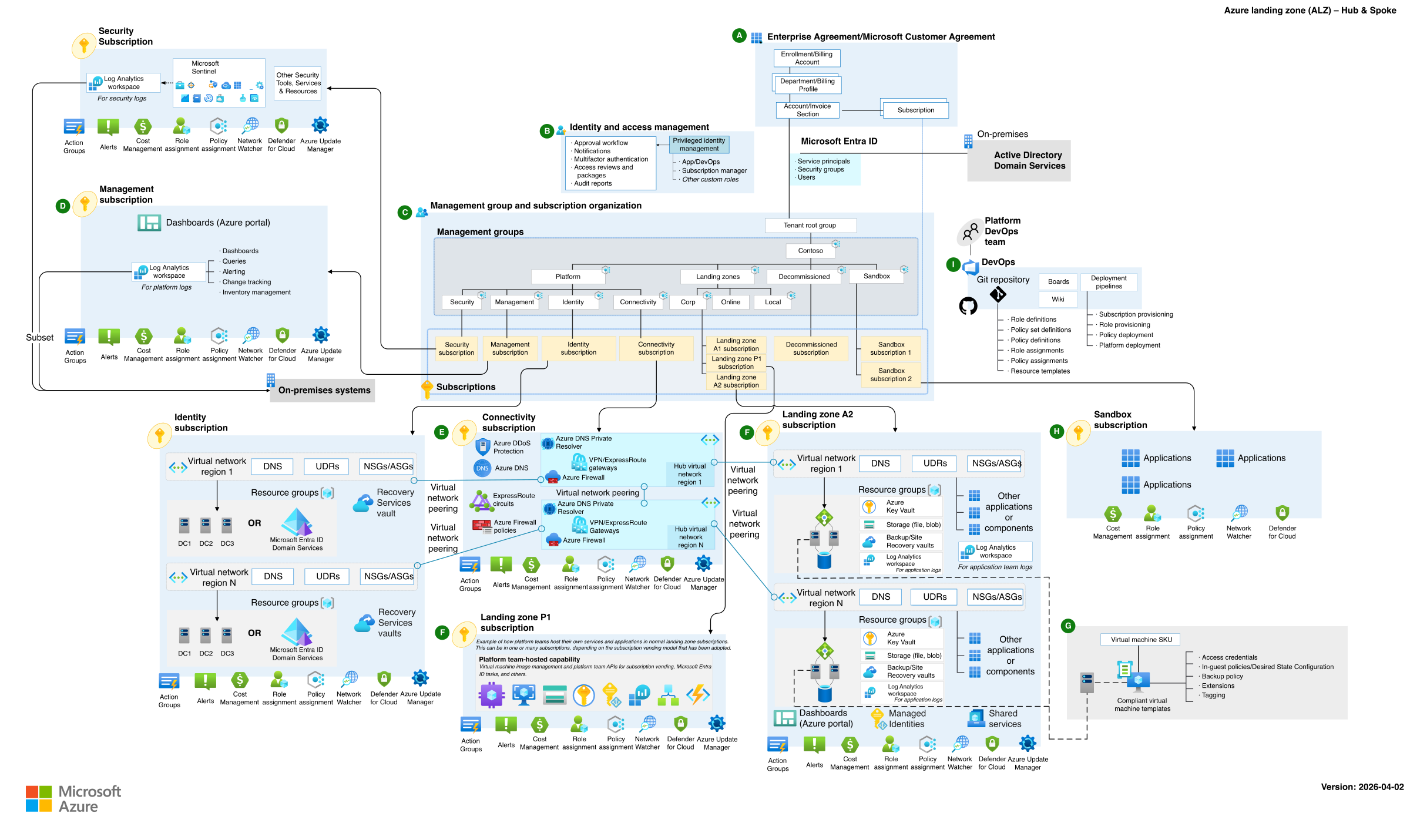
Role: Reference analysis, requirements mapping, and enterprise blueprint tailoring
Enterprise Azure adoption needs more than a workload VNet. Teams must define the tenant and management-group hierarchy, subscription model, identity controls, shared connectivity, centralized security and management services, policy guardrails, platform automation, and ownership boundaries before workloads scale.
- Translate organizational and regulatory requirements into management groups, platform subscriptions, application landing zones, and sandbox boundaries.
- Centralize hybrid connectivity, DNS, firewall policy, DDoS protection, and shared routing in the connectivity subscription and hub virtual networks.
- Align Microsoft Entra ID, privileged access, RBAC, Azure Policy, Defender for Cloud, Sentinel, and centralized logging with the operating model.
- Tailor the reference blueprint into a phased landing-zone backlog covering platform automation, subscription vending, workload onboarding, and operational ownership.
A decision-ready enterprise foundation pattern that makes governance, connectivity, security, management, automation, and workload isolation explicit before implementation begins.
Reference: Microsoft Cloud Adoption Framework — Azure landing zone architecture, Microsoft.
Amazon Web Services reference blueprint
AWS Multi-Account Security & Network Landing Zone
An enterprise AWS organization pattern separating management, security, log archive, network, shared services, and workload accounts with centralized controls and inspected network paths.
- AWS Organizations
- AWS Control Tower
- AWS IAM Identity Center
- AWS Transit Gateway
- AWS Network Firewall
Architecture and approach
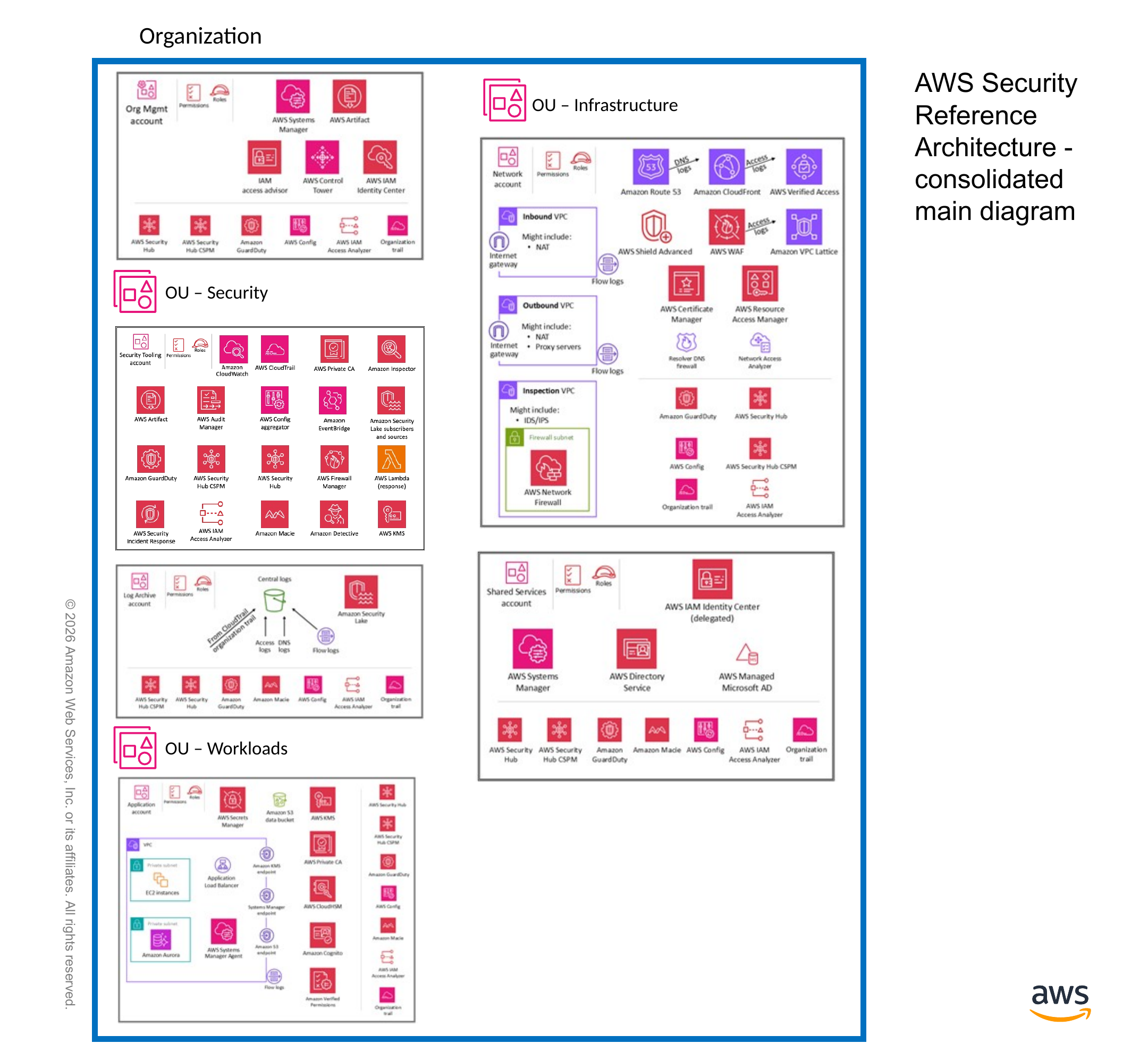
Role: Landing-zone assessment, multi-account design, and security-control tailoring
Scaling AWS safely requires deliberate account and organizational-unit boundaries, centralized identity and audit services, governed workload onboarding, shared networking, inspection, logging, and delegated security administration rather than accumulating production workloads in a single account.
- Define an AWS Organizations and organizational-unit model that separates management, security, infrastructure, shared services, and workload responsibilities.
- Centralize audit and security operations through dedicated Log Archive and Security Tooling accounts with organization-wide trails and delegated administration.
- Use a dedicated Network account for inbound, outbound, and inspection VPCs, centralized routing, DNS, firewall services, and shared network controls.
- Tailor preventive and detective guardrails, account provisioning, logging, incident response, and workload onboarding to the organization’s risk and operating model.
A scalable AWS landing-zone model that reduces blast radius, strengthens separation of duties, and gives platform and security teams a governed path for onboarding accounts and workloads.
Reference: AWS Security Reference Architecture, Amazon Web Services.
Google Cloud reference blueprint
Google Cloud Enterprise Foundation & Shared VPC
A governed Google Cloud foundation combining organization policy, resource hierarchy, IAM, GitOps delivery, multi-region Shared VPC, private connectivity, centralized security, secrets, logging, and monitoring.
- Google Cloud
- Resource Manager
- Organization Policy
- IAM
- Shared VPC
Architecture and approach
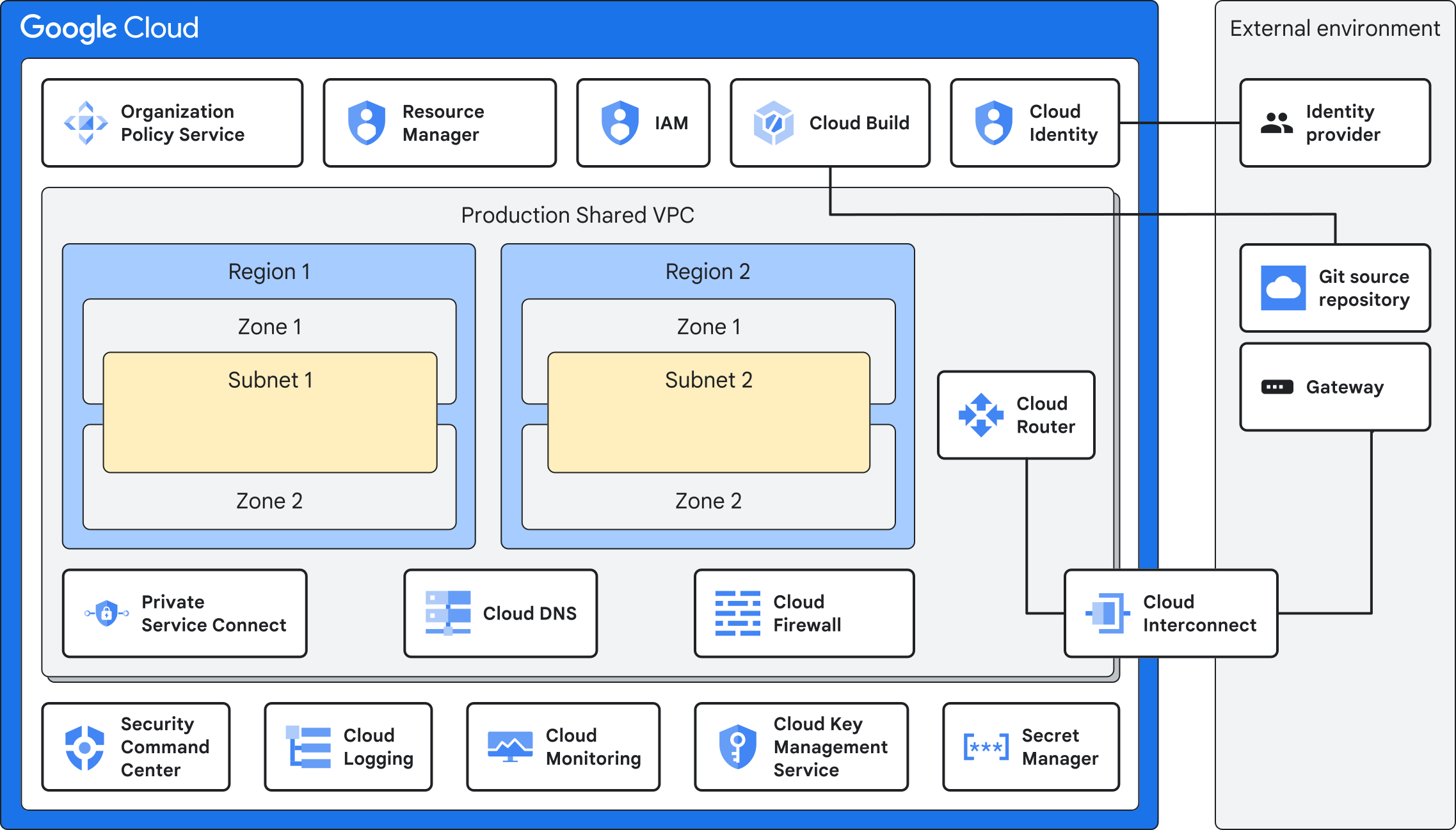
Role: Foundation assessment, guardrail mapping, and blueprint adaptation
Enterprise Google Cloud adoption needs a consistent resource hierarchy, centrally managed networks, federated identity, policy enforcement, private service paths, security operations, audit logging, encryption, secret management, and repeatable infrastructure delivery across projects and environments.
- Map business units, environments, and ownership boundaries into the organization, folder, project, and IAM hierarchy.
- Use centrally managed Shared VPC networks across regions with private service access, Cloud DNS, Cloud Firewall, Cloud Router, and hybrid connectivity.
- Apply organization policies, Security Command Center, centralized logging and monitoring, Cloud KMS, and Secret Manager as foundation controls.
- Use Terraform and Cloud Build to make platform changes reviewable, policy-checked, and repeatable through a GitOps operating model.
An enterprise-ready Google Cloud foundation pattern that makes governance, shared networking, security controls, private connectivity, and platform automation consistent across workload projects.
Reference: Google Cloud Enterprise Foundations Blueprint, Google Cloud.
Backend & AI Engineering
Private Azure RAG & Document Intelligence Platform
A backend-focused Azure architecture connecting separate application services to private data, containers, retrieval, document processing, secrets, and observability.
- Azure App Service
- PostgreSQL
- Azure AI Search
- Document Intelligence
- Azure AI Foundry
Architecture and approach
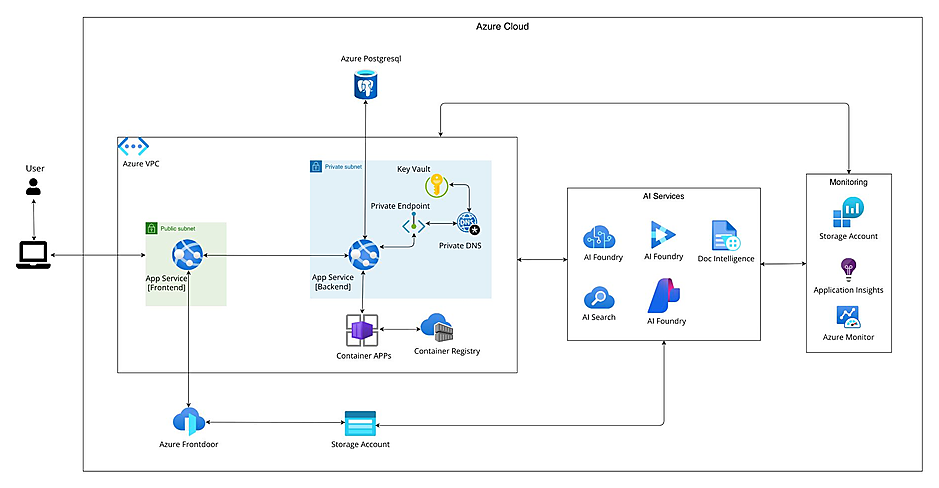
Role: Backend service architecture, API and data boundaries, and AI integration
A generative-AI application needed retrieval, document processing, and managed data services behind controlled public and private boundaries. Frontend and backend responsibilities also needed to remain independently deployable and observable.
- Separate the public frontend from the backend application service and place backend dependencies on controlled private service paths.
- Use private PostgreSQL, private endpoints, private DNS, and Key Vault for data and secret boundaries.
- Connect containerized workloads through Azure Container Apps and Azure Container Registry.
- Integrate Azure AI Search, Document Intelligence, AI Foundry, storage, Application Insights, and Azure Monitor as explicit platform services.
A governed RAG foundation that separates backend, AI, data, and operations responsibilities and supports a controlled path from proof of concept to production.
AI Engineering
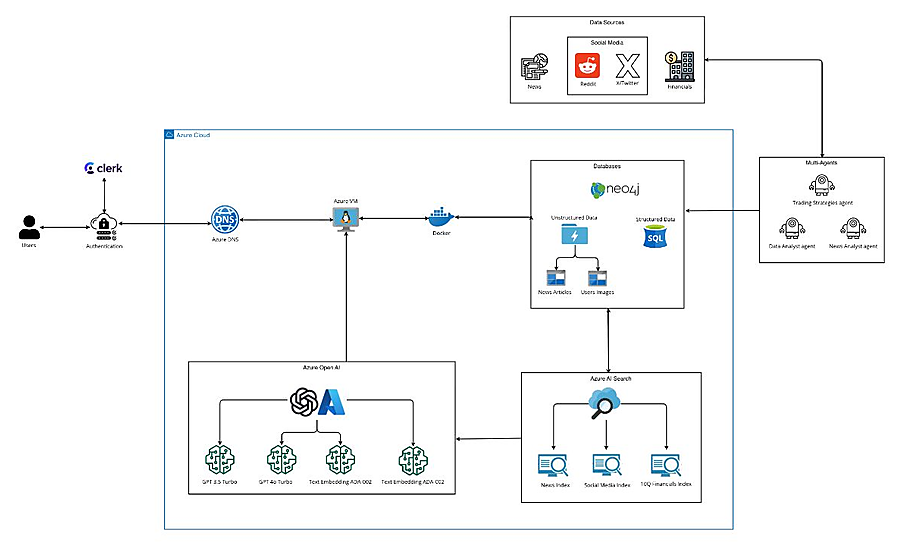
Azure Multi-Agent Intelligence & RAG Platform
An AI-infrastructure pattern that connects specialist agents to governed data, semantic retrieval, shared model services, and deployable application components.
- Azure OpenAI
- Azure AI Search
- RAG
- Multi-Agent Systems
- Embeddings
Architecture and approach
Role: AI platform architecture, retrieval design, and service integration
A research and intelligence platform needed to combine external news, social, and financial data with structured analysis, semantic retrieval, and specialist agent workflows without creating disconnected data or model silos.
- Separate ingestion, structured data, unstructured content, search indexes, graph relationships, and agent responsibilities.
- Use Azure AI Search for purpose-specific indexes and Azure OpenAI for chat and embedding workloads.
- Containerize the application path and keep authentication, DNS, data, retrieval, and model interactions explicit.
- Give each agent a bounded responsibility while sharing governed retrieval and model services.
A reusable architecture for multi-agent applications that keeps data, retrieval, models, and specialist workflows understandable, governable, and independently evolvable.
Cloud Architecture
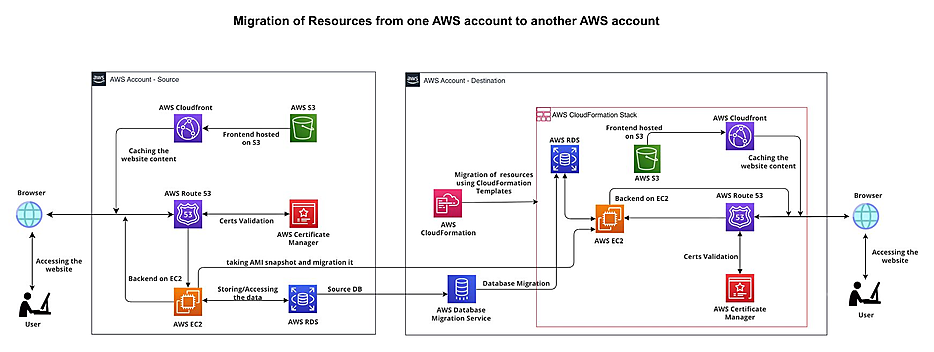
AWS Cross-Account Migration & Modernization
A controlled migration blueprint for moving a web platform between AWS accounts while making infrastructure, data, certificate, DNS, compute, and cutover dependencies explicit.
- AWS Migration
- CloudFormation
- AWS DMS
- EC2
- RDS
Architecture and approach
Role: Migration architecture, dependency mapping, and cutover planning
A web application spanning edge delivery, DNS, compute, certificates, object storage, and relational data needed to move from a source AWS account to a governed destination account with a clear sequence and rollback path.
- Map source-to-destination dependencies before migration begins, including DNS, certificates, frontend assets, compute images, and relational data.
- Recreate the destination foundation with CloudFormation rather than relying on undocumented manual configuration.
- Use AWS Database Migration Service for the relational data path and an explicit image-transfer process for compute.
- Define validation and cutover checkpoints so traffic changes can be phased and reversed if required.
A migration design that exposes hidden dependencies early and supports phased execution, technical validation, rollback planning, and clearer stakeholder communication.
MLOps
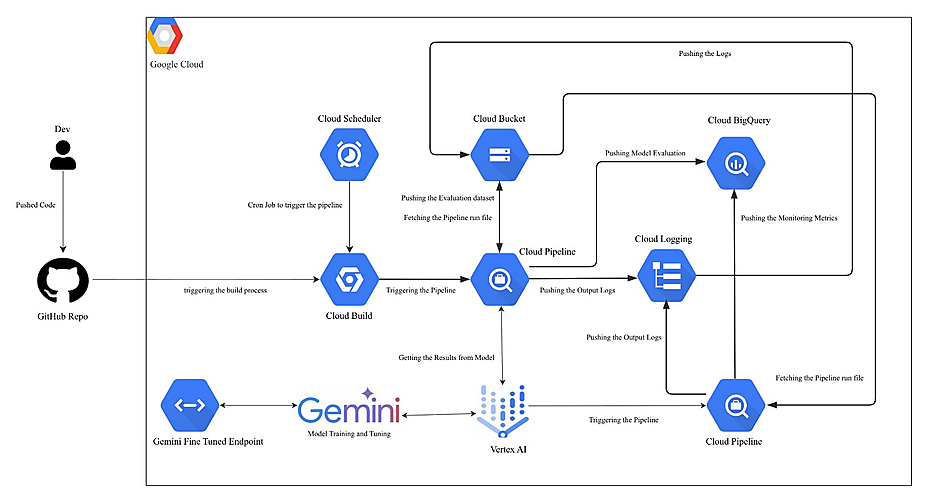
Vertex AI MLOps & Model Evaluation Framework
A controlled Google Cloud MLOps loop for repeatable model training, evaluation, artifact handling, telemetry, and promotion decisions.
- Google Cloud
- Gemini
- Vertex AI
- Vertex AI Pipelines
- Cloud Build
Architecture and approach
Role: MLOps architecture, evaluation workflow, and observability design
A fine-tuned Gemini workflow needed repeatable training and evaluation, retained pipeline artifacts, centralized operational signals, and a traceable path from source change to model-quality review.
- Trigger repeatable workflows through Cloud Build, Cloud Scheduler, and Vertex AI Pipelines.
- Retain evaluation datasets and pipeline artifacts in Cloud Storage rather than treating runs as ephemeral.
- Send logs and evaluation outputs to Cloud Logging and BigQuery for inspection and comparison.
- Keep model tuning, evaluation, monitoring, and promotion signals connected in one architecture.
A governed MLOps framework that helps teams inspect model quality and platform behaviour before promotion and supports more deliberate release decisions.
Platform & DevOps
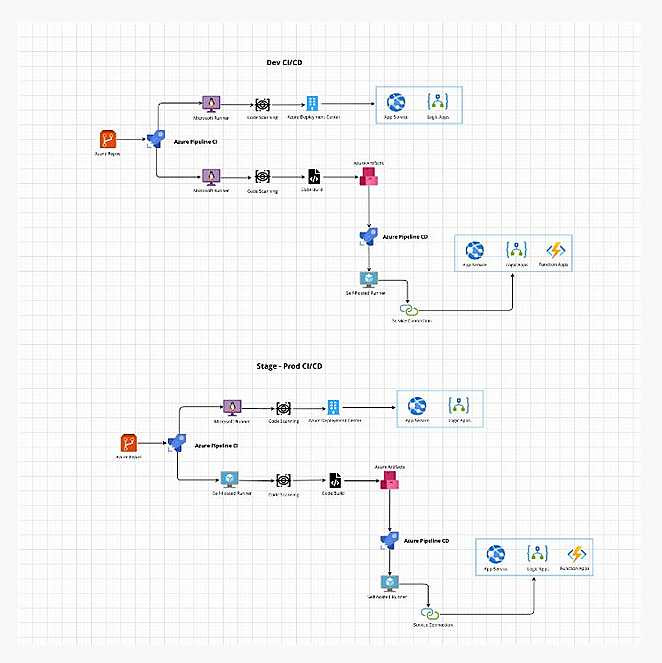
Secure Multi-Environment Azure CI/CD Platform
A release-governance pattern that separates development, staging, and production delivery while keeping identities, runners, artifacts, checks, and service connections explicit.
- Azure DevOps
- Azure Repos
- Azure Pipelines
- CI/CD
- Code Scanning
Architecture and approach
Role: Delivery architecture, environment governance, and deployment controls
Development, staging, and production services needed consistent builds and promotions without sharing identities, agents, artifacts, or release controls across environments.
- Separate development and stage-to-production delivery paths with environment-specific identities and service connections.
- Run build, test, code-scanning, and artifact stages before deployment promotion.
- Use controlled self-hosted agents and explicit deployment targets for App Service, Logic Apps, and Function Apps.
- Keep approvals, checks, and environment boundaries visible in the delivery architecture.
A repeatable delivery path with clearer separation of duties, security checks, approval points, and environment-specific deployment controls.
Platform & DevOps
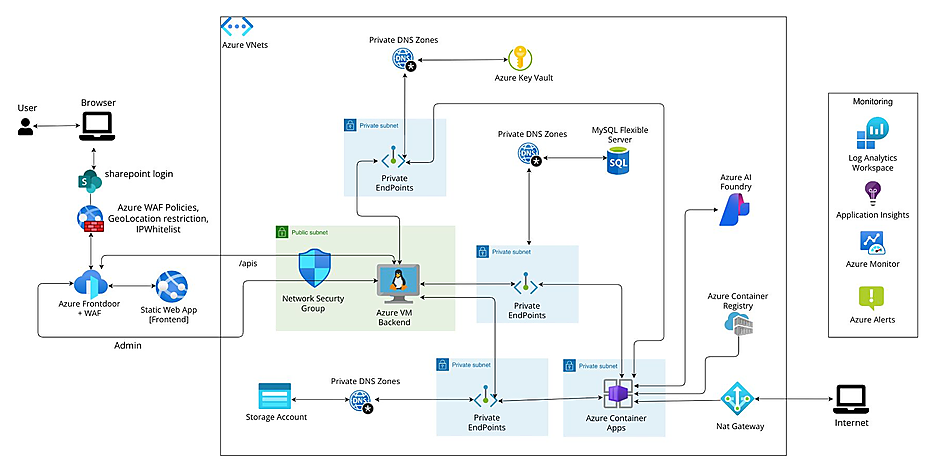
Secure Azure AI Application Platform
A production-minded Azure platform combining protected ingress, private service connectivity, managed application services, AI capabilities, and repeatable infrastructure delivery.
- Azure Front Door
- WAF
- Azure VNet
- Private Endpoint
- Container Apps
Architecture and approach
Role: Solution architecture, security boundaries, and Terraform planning
An internet-facing AI application needed a reliable public entry point while keeping compute, data, containers, secrets, and model services on controlled paths. The platform also needed to remain operable and repeatable across environments.
- Place Azure Front Door and Web Application Firewall at the public edge for routing and request protection.
- Segment application and managed-service traffic with virtual networks, private endpoints, and private DNS.
- Use managed application, database, container, secret, AI, and monitoring services with explicit trust boundaries.
- Represent the platform as reusable Terraform modules so environment changes remain reviewable and repeatable.
A clear platform blueprint that improves service isolation, operational visibility, and deployment consistency while keeping AI services inside the wider application security model.
Backend & AI Engineering
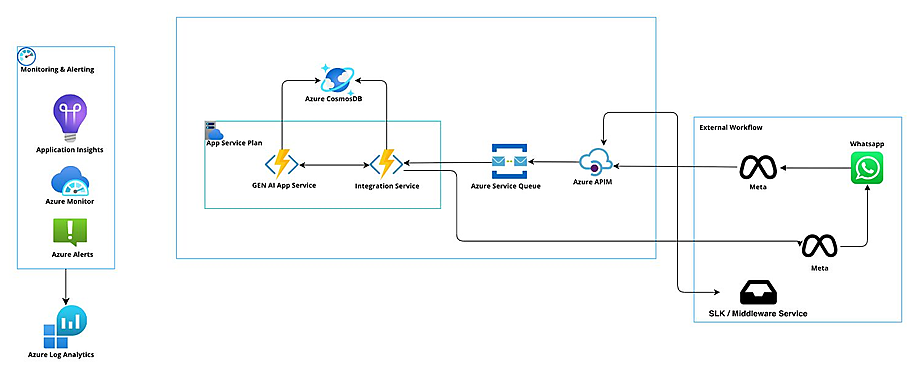
Event-Driven WhatsApp AI Support Platform
A backend integration architecture connecting WhatsApp, AI processing, conversation state, asynchronous messaging, escalation services, and operational telemetry.
- Azure API Management
- Service Bus
- Azure AI
- Cosmos DB
- App Service
Architecture and approach
Role: Backend integration, asynchronous workflow, and AI service architecture
A customer-support workflow needed a governed connection between WhatsApp, AI processing, conversation state, external services, escalation, and monitoring without tightly coupling the public channel to backend processing.
- Use API Management as the controlled entry point for the external messaging channel.
- Decouple requests with Service Bus so AI and integration workloads can process asynchronously.
- Keep conversation state in Cosmos DB and separate AI processing from integration and middleware responsibilities.
- Connect Application Insights, Azure Monitor, alerts, and Log Analytics to the operational path.
A resilient support architecture that separates external traffic, asynchronous processing, AI orchestration, data, escalation, and observability concerns.
Platform & DevOps
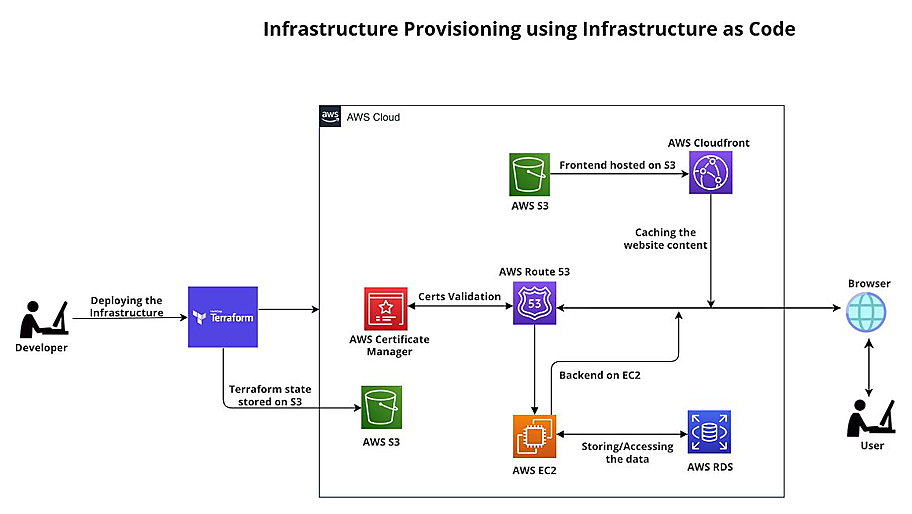
Terraform-Provisioned AWS Web Platform
A repeatable infrastructure-as-code pattern for an AWS web platform spanning edge delivery, DNS, certificates, compute, relational data, and remote Terraform state.
- AWS
- Terraform
- Remote State
- S3
- CloudFront
Architecture and approach
Role: Infrastructure-as-code design, platform architecture, and delivery planning
A web application needed consistent environments and clear boundaries for frontend delivery, backend compute, relational data, DNS, certificates, and Terraform state.
- Use Terraform as the provisioning entry point and retain remote state in S3.
- Serve the static frontend from S3 through CloudFront for edge delivery.
- Manage DNS and certificate validation through Route 53 and AWS Certificate Manager.
- Keep the application and data tiers explicit through EC2 and RDS service boundaries.
A straightforward infrastructure-as-code pattern that supports repeatable environments, modular automation, and a clear path from provisioning to application delivery.
Cloud Architecture
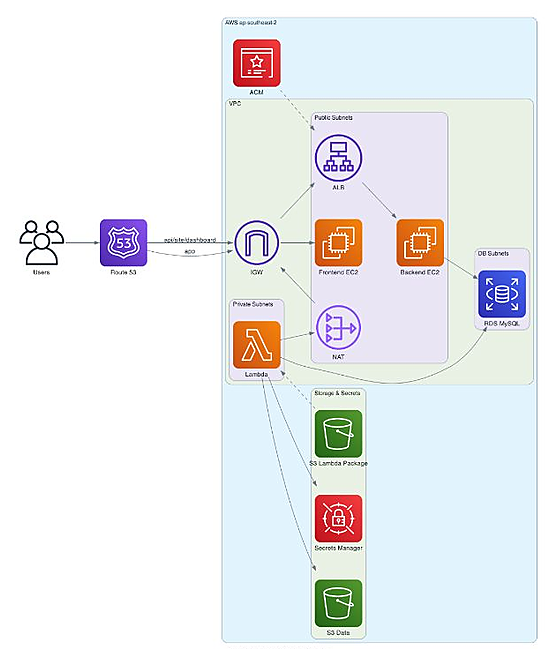
Layered AWS VPC Web Application Platform
A layered AWS application architecture with centralized ingress, separated frontend and backend compute, managed data, serverless processing, packages, and secrets.
- AWS VPC
- Route 53
- ACM
- Application Load Balancer
- EC2
Architecture and approach
Role: Network and application architecture, workload segmentation, and service integration
A web application required controlled ingress, certificate management, separate compute roles, relational data, serverless processing, and managed storage and secrets inside a structured VPC.
- Centralize DNS, certificates, and ingress with Route 53, ACM, and an Application Load Balancer.
- Separate frontend and backend EC2 responsibilities within the application network.
- Place relational data in a dedicated RDS for MySQL service boundary.
- Connect Lambda, NAT, S3 package and data locations, and Secrets Manager through explicit managed paths.
A clear network and service layout that centralizes ingress and certificates, separates workload roles, and provides managed paths for data, packages, and secrets.
Platform & DevOps
Microsoft Fabric CI/CD & GitOps Automation
A data-platform delivery workflow for promoting Fabric workspace content through setup, preparation, deployment, validation, notification, and audit stages.
- Microsoft Fabric
- Azure Pipelines
- GitOps
- CI/CD
- Microsoft Entra ID
Architecture and approach
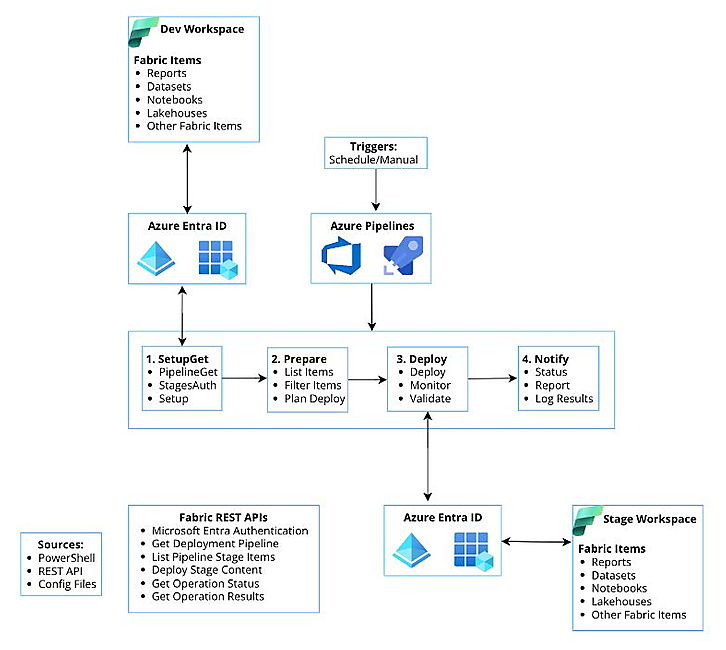
Role: Data-platform delivery architecture, API automation, and environment promotion design
Data-platform teams needed a repeatable way to promote Fabric reports, datasets, notebooks, lakehouses, and related workspace content between environments.
- Use Azure Pipelines to coordinate setup, preparation, deployment, validation, and notification stages.
- Authenticate workspace operations through Microsoft Entra ID rather than embedded credentials.
- Automate Fabric operations through REST APIs, PowerShell, configuration files, and deployment pipeline controls.
- Retain status, monitoring, and result information so promotion activity remains traceable.
A controlled and auditable promotion process that brings software-delivery discipline to Microsoft Fabric workspace operations.